A couple weeks ago two friends of mine were moving rental chairs around in preparation for their wedding when the groom-to-be cut his hand on a rusty portion of a chair leg. It wasn’t a super deep cut, but he did need to wrap a bandage around his hand to stop the bleeding. While he was treating his wound his fiancée asked him, “Do you know if you’re up-to-date on your tetanus shot?”
“Not sure, I don’t remember,” he replied.
“It should be in your medical history, we can look online.” His fiancée pulled out her phone and went to MyChart’s website. “Who’s your PCP?”
“Hmm not sure, I can’t remember.”
“You…can’t remember your PCP?” his fiancée responded surprised. “When’s the last time you went to see him?”
“Eh, probably like, high school? Yea I think I needed a physical before I went off to college.”
That was 16 years ago.

When I first heard this story, I couldn’t help but laugh.Oh, hi! This is probably the first time you’re seeing one of these. I go on tangents sometimes so I put them in the margin here to not interrupt your reading flow. Feel free to ignore them if you’re not interested in my tangential ramblings. Please carry on brave warrior. I couldn’t believe someone had gone more than a decade without seeing a doctor. While I know that’s common for many Americans who can’t afford to see a doctor due to the American medical system, that’s not the case for my friend. He has a good job with great benefits, including healthcare. When I asked him why he hadn’t gone to the doctor in 16 years, I was expecting him to say that he’d had a significantly poor experience with a doctor in the past or something like that, but he responded untroubledly “just didn’t feel like I needed to.”
As I shared this story with other friends and family, I started to notice a trend: many adult men, all with affordable health insurance, did not see their doctor on a regular basis.
What? Why? For how unergonomic and hostile the American healthcare system is, why wouldn’t you go to the doctor if you can afford it and it’s readily available? Yea yea copays and deductibles are a thing and yes you have to take time off work, but I still couldn’t rationalize it. Not for 16 years at least. I started to wonder if the local trend I had observed was reflected among American men more broadly. And if it was, were all of these men really making the same individual choice not to go?
Let’s start by trying to understand if my friend’s experience points to a broader pattern among American men. To do so, I took a look at the Medical Expenditure Panel Survey (MEPS) [1], which tracks national healthcare and doctor-visit statistics.The 2023 MEPS sample included 18,463 weighted respondents, representing about 334.5 million Americans. After a brutal hour quick few minutes of very real data science, I was able to put together a few charts.Lord give me patience with R, I had to feed my French cousin Claude the finest of baguettes to convince him to help me with this. So you don’t have to repeat my suffering (and if you’re curious), here are the raw, resultant data sets I derived from MEPS: mean and median provider visits, zero provider visits, provider visit distribution.
First, let’s look at the average number of times Americans go to the doctor’s office per year.
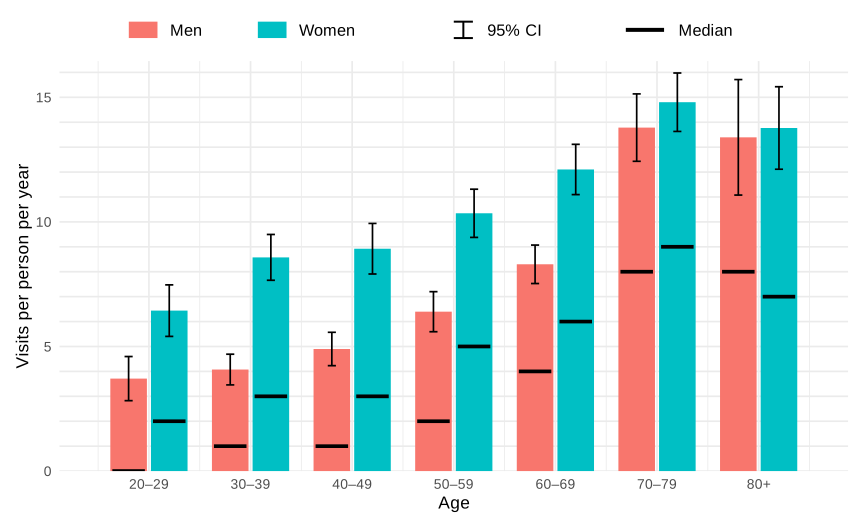
source: AHRQ Medical Expenditure Panel Survey, 2023
OK, so now we’re getting somewhere. For Americans under 70, we can clearly see that on average (both mean and median) that women are going to the doctor more often than men. For example, the average number of annual non-emergency visits for men in their 20s is ~3.71, while for women in the same bracket is ~6.44. This doesn’t mean that on average young men are going to the doctor 4 times a year - remember that the mean can be pulled up or down by outliers. So, looking at the median, it’s potentially more accurate to say that the typical American man in his 20s goes to the doctor zero times a year while the typical American woman in her 20s goes twice.I can already hear the something something methodology replies on Twitter (thus why buttermilk doesn’t have comments), so let’s talk about it. The data collected via MEPS is from a computer-assisted questionnaire where one household respondent reports information for all household members. It’s self reported, which means…people could kinda say anything. As I’m sure you know, since I’m assuming you’re a person (shoo Claude), people aren’t always excellent about telling the truth, even if they’re not trying to be dishonest. So even though a lot of the charts here seem to line up with the anecdotes below, we should probably still take it all with a grain of salt.
A few other things worth calling out about MEPS: respondents are noninstitutionalized US civilians, “visits” can mean anything from a virtual visit/phone call to walking into the doctor’s office, and the men/women split is sex, not gender identity.
Looking at this pattern another way, what percentage of people don’t see a doctor even once in a given year? Take a look at this chart.
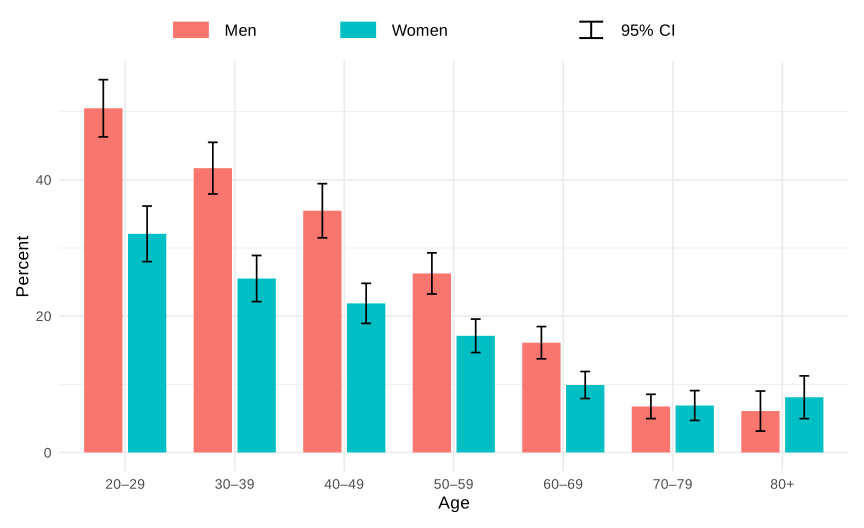
source: AHRQ Medical Expenditure Panel Survey, 2023
Well that makes the pattern much harder to dismiss. If my “expert” data science skills are correct, this is saying that more than half of American men in their 20s don’t see a doctor on an annual basis (and it doesn’t seem to be a phenomenon limited to Americans [3]). What’s also interesting, and less expected, is the number is still ~32% for the respective group of women. Overall, seems like many Americans don’t go to the doctor regularly, even if men are the ones going less frequently.
Perhaps in one final figure that puts all of this information in one chart.
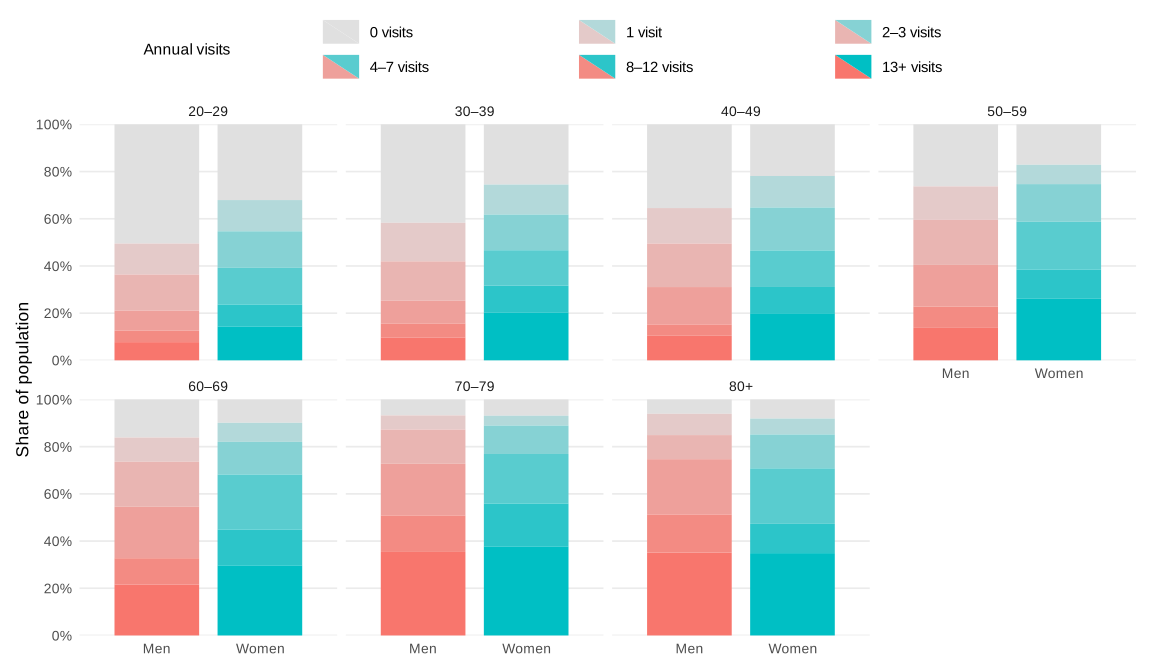
source: AHRQ Medical Expenditure Panel Survey, 2023
In this graphic you can see a larger portion of the women’s bars is brighter in color than the men’s bars. In a way, another chart to confirm something probably obvious to many of you reading this.
Okay math class is over.Oh, you wanted to get really nerdy about how I arrived at these numbers? I’m glad you asked. MEPS reports a variety of variables for each data point (person) in its dataset. I used the following in my calculations: AGE23X - the age as of 12/31/23, SEX - the sex, OBTOTV23 - the number of office-based provider visits in 2023, OPTOTV23 - the number of outpatient department provider visits in 2023, PERWT23F - the statistical weight applied to this respondent to estimate the US civilian noninstitutionalized population, VARSTR - the variance estimation stratum used to calculate CI, and VARPSU - the primary sampling unit used with VARSTR for CI estimation.
To derive the main metric used in the charts here, I used annual non-emergency healthcare visits = OBTOTV23 + OPTOTV23.
So I think it’s fair to say that men are going to see the doctor less than women on average. But that doesn’t answer the more interesting question…why?
To get more anecdotal evidence, I went to the one bastion on the internet where it seems humans still contribute regularly in mass,Seems like Reddit is mostly still human authored [4], which I guess when you read some of the takes on Reddit that’s actually not surprising? Reddit does feel more human to me.
What’s also not surprising is like 40% of LinkedIn is AI generated. I’m honestly surprised it’s not higher. I don’t know why anyone actually reads LinkedIn, it’s been filled with slop far before Sam Altman. especially men: Reddit [5]. Look at what I found when men were asked why they didn’t go to the doctor regularly (or at all):
Because most of the time doctors don’t take me seriously or speak to me in a condescending manner like I’m a child.
Maybe if a doctors visit didn’t have the capacity to financially ruin me I’d be more inclined.
Well personally it’s because it’s really fucking difficult to see a doctor.
Yea, all totally reasonable. Nobody wants to be talked down to, doctors are rushed and overbooked, and it’s unnecessarily expensive even for preventative visits.
But, none of those reasons are unique to men. Women are condescended by doctors (often more than men) and they operate in the same broken system that men do. I bet if you asked women on Reddit why they don’t want to see a doctor they’d say a lot of the same things: they don’t feel listened to, it’s expensive, and it’s a hassle. Maybe the difference isn’t that men face a completely different set of barriers, but rather men are more likely to respond to the same barriers by opting out. But still - why?
There are plenty of reasonable explanations for why men avoid the doctor, and I don’t think most of them are wrong. Men can be embarrassed about bringing up health concerns [6], and sometimes traditional ideas about masculinity, like valuing bravery, toughness, and self-sufficiency, can lead to actively avoiding medical care [7][8].
From the outside, going to the doctor can look like a simple, binary decision. You know you should go, and so you either do the responsible thing or you don’t. And from there it’s very easy to conclude that men who don’t go are being stubborn, lazy, or reckless.
But I don’t think it’s that simple. If you’ve spent your entire life absorbing the idea that capable men handle their problems on their own and don’t need to ask for help, then when exactly do you decide you really need it? I don’t think this is simply men deciding not to go. Avoiding the doctor may be less an isolated decision than a symptom of how American men are taught to think about independence, vulnerability, and asking for help.I think an example of this is the term man flu [9], which refers to the perceived embellished severity of symptoms when a man is sick. Men aren’t supposed to complain, and when they do we’ve coined a special term for so-called “outliers”, as if feeling miserable while you’re sick isn’t one of the defining characteristics of being sick.
There’s another asymmetry here too: many women are pulled into routine healthcare relatively young, through contraception, reproductive care, and other regular appointments. Men can often opt-out much more easily. That probably changes what “normal” healthcare use feels like later in adulthood.
It’s easy to point at a man who skipped his annual check-up and see laziness or poor decision making. But if you’ve spent your whole life hearing some version of man up when you’re hurt, then I think “he should have just gone to the doctor” deserves a little more nuance. When our culture prizes self-reliance and seeing the doctor is expensive and inconvenient, eventually toughing it out can become the default.

Reflecting on all of this, it makes me sad that many men don’t feel like they can ask for help when they need it. It’s a lonely way to struggle. Men engage in more high-risk behavior, receive less advice about changing risk factors, and spend less time with doctors during medical encounters [10]. Those Reddit comments about not feeling heard aren’t just internet anecdotes.Did you know that men die from skin cancer twice as often as women despite it occurring in men half as often [11]?
None of this means men are powerless to make different choices. But, it’s easy to forget those choices don’t happen in a vacuum. For many American men, masculinity can quietly shape what counts as sick enough, how long you’re supposed to tolerate something yourself, and when asking for help finally feels justified.
Gentlemen, if you’re reading this, going to the doctor isn’t fun. You’re right: doctors can be condescending, appointments can be difficult to get, and American healthcare can be prohibitively expensive. Those barriers are real regardless of masculinity. But if you have access to care, maybe don’t wait until you feel like you need it. As with many important things, waiting too long can make solvable problems permanent.
🥛